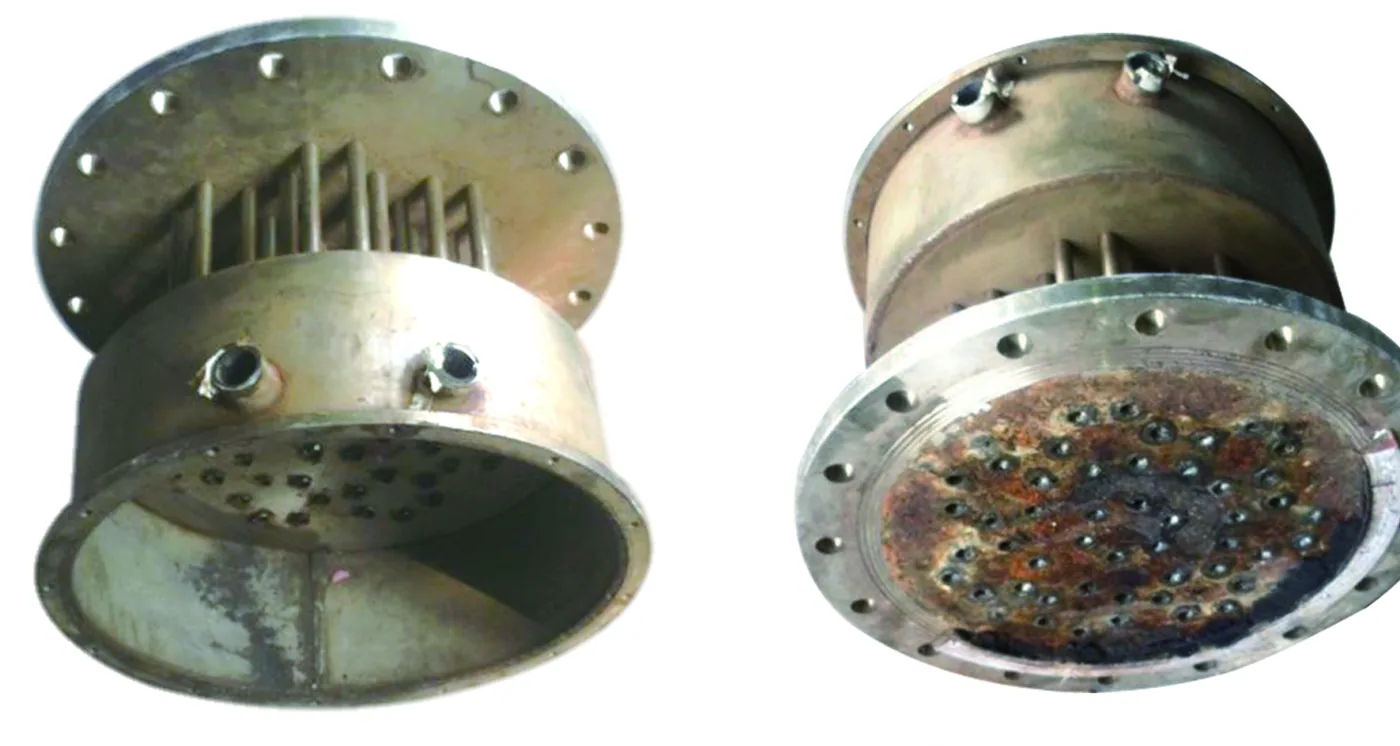
Explosion-proof heater vessel halves showing the flanged tube sheet
Thermoplongeur antidéflagrant à bride
防爆电加热管 / 防爆电加热器
Faisceau de tubes à bride dans une capacité sous pression avec boîte de raccordement antidéflagrante, pour élever, maintenir ou surchauffer des liquides et des gaz en circulation en zone classée.
- Max medium temperature
- 842 °F(450 °C)
- Power range
- 3 – 200 kW
- Voltage
- 220 / 380 V, 50 Hz
- Sheath material
- 304 stainless, 316 stainless, 316L stainless, Incoloy 800
- Medium
- Oil, Water, Steam, Solvent
- Mounting
- Flange
- Tube diameter
- 0.472–0.63 in
- Pressure rating
- 116–580 psi
- Lead time
- 30–55 days
- MOQ
- 1 unit
- Pricing
- On application
Design notes
Boîte antidéflagrante, circulation chicanée, limiteur indépendant
An explosion-proof heater is a system, not an element. Process fluid enters the vessel under pressure and is routed along a designed path by internal baffles, so it sweeps every heated tube instead of short-circuiting between the inlet and outlet. That flow path is what lets the assembly deliver a high outlet temperature with a uniform sheath temperature — the two goals that pull against each other in every immersion design.
Control is closed-loop on the outlet. A sensor at the discharge feeds back to the power controller, which modulates output to hold the set-point as flow and inlet temperature vary. Independently of that loop, a separate over-temperature element sits in the bundle and cuts the supply outright if the sheath exceeds its limit. That second device is what prevents the heated product from coking, degrading, carbonizing or scorching — and it is the reason the assembly survives an upset that would destroy a bare element.
The flameproof enclosure covers the terminal end, where a loose connection could arc. Field wiring enters through certified glands, and the enclosure's construction contains any internal ignition rather than excluding gas from it. The heated bundle itself carries the pressure boundary through the flange.
Features
- Boîte de raccordement antidéflagrante avec presse-étoupes certifiés
- Capacité à chicanes internes — le fluide balaie chaque tube
- Régulation en boucle fermée de la température de sortie par gradateur
- Élément de surtempérature indépendant sur circuit de coupure directe
- Gaine 304 / 316 / 316L ou Incoloy 800 selon le fluide et la température
Typical applications
- Chauffage de procédé chimique et séchage sous pression
- Chauffage d'hydrocarbures — brut, fioul lourd, combustible, huile thermique, lubrifiant, paraffine
- Eau de procédé, vapeur surchauffée, sels fondus et azote
- Surchauffe de gaz à l'eau et de gaz de procédé
- Plateformes offshore, marine, défense, pétrole et mines
North American build options
- Voltage
- 120 / 208 / 240 / 277 / 480 / 600 V @ 60 Hz
- Threads
- NPT or BSP cut to order
- Flanges
- ANSI B16.5 150# / 300#
- Drawings
- Issued in inches on request
These are build options, not stock items — the catalog part numbers above are 50 Hz with metric fine threads. State what you need on the RFQ.
Part numbers & dimensions
8 catalog part numbers in the JGB series
Every explosion-proof assembly is engineered to the duty. Send the fluid, mass flow, inlet and outlet temperature, design pressure, area classification and gas group with your inquiry — the SKU codes above are indicative frame sizes, not a stock list.
Minimum order quantity for this series is 1 unit. Dimensions switch between millimetres and inches with the unit toggle in the header.
Full specification
- Enclosure
- Flameproof terminal housing, certified glands
- Sheath material
- 304 / 316 / 316L stainless or Incoloy 800
- Vessel design pressure
- 0.8 – 4 MPa typical
- Outlet temperature
- To 450 °C depending on fluid
- Assembly power
- 3 – 200 kW; larger to inquiry
- Voltage
- 220 V or 380 V, 50 Hz
- Control
- Closed-loop outlet sensor to power controller
- Safety
- Independent over-temperature element, hard-break
- Flow path
- Internally baffled for full-bundle sweep
Questions engineers ask
What information do you need to quote an explosion-proof heater?
Nine things: the fluid by name, mass or volumetric flow rate, inlet temperature, required outlet temperature, design pressure, area classification and gas group, supply voltage and frequency, flange standard, and any client specification you work to. Without flow rate and the two temperatures there is no kilowatt figure, and without the area classification the enclosure cannot be specified.
Why is the over-temperature element separate from the control sensor?
Because a control loop can fail in a way that leaves the heater energized — a sensor drifts, a controller output sticks, a triac fails closed. The high-limit element sits in the bundle on its own circuit and breaks the supply through a hard contactor regardless of what the controller believes. That independence is the whole point; a high-limit sharing the controller's sensor or output protects nothing.
What do the internal baffles actually do?
They force the fluid across the full tube bundle instead of letting it take the shortest path from inlet to outlet. Without baffles, part of the bundle sits in near-stagnant fluid and overheats while the bulk stream leaves under-heated — you get both a hot spot and a cold outlet. The baffle layout is what makes high outlet temperature and uniform sheath temperature achievable at the same time.
Can you supply to a specific Ex certification?
Tell us the certification and the market at inquiry stage. The enclosure, glands and documentation package differ between schemes, and it is far cheaper to build to the right scheme than to re-certify afterwards. Where a scheme requires third-party assessment we will say so in the quotation rather than after the order.
Commonly specified with
Related series
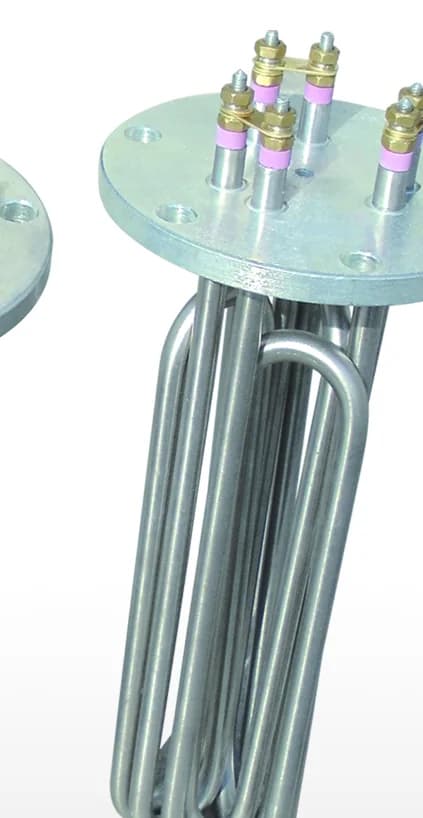 JGSSur plan
Thermoplongeur JGS pour chaudière et eau
Montage à bride ou fileté, étanche de 0,8 à 4 MPa
- Temp. max.
- 320 °F
- Puissance
- 1–45 kW
- Références
- 13
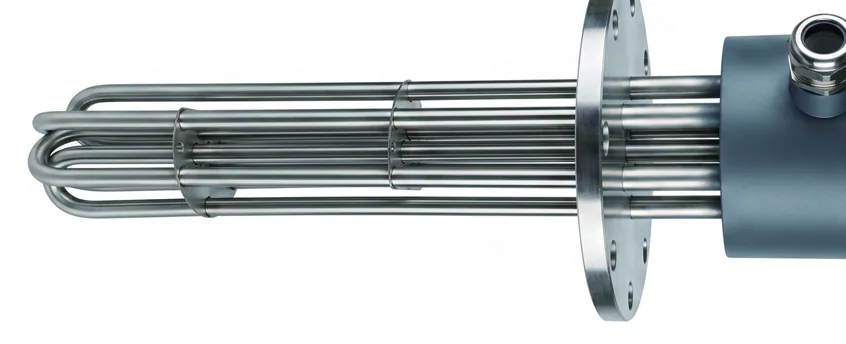 JGYSur plan
Élément à immersion dans l'huile JGY
Bacs d'huile ouverts et fermés, 1 à 8 kW en 220 V
- Temp. max.
- 572 °F
- Puissance
- 1–8 kW
- Références
- 11
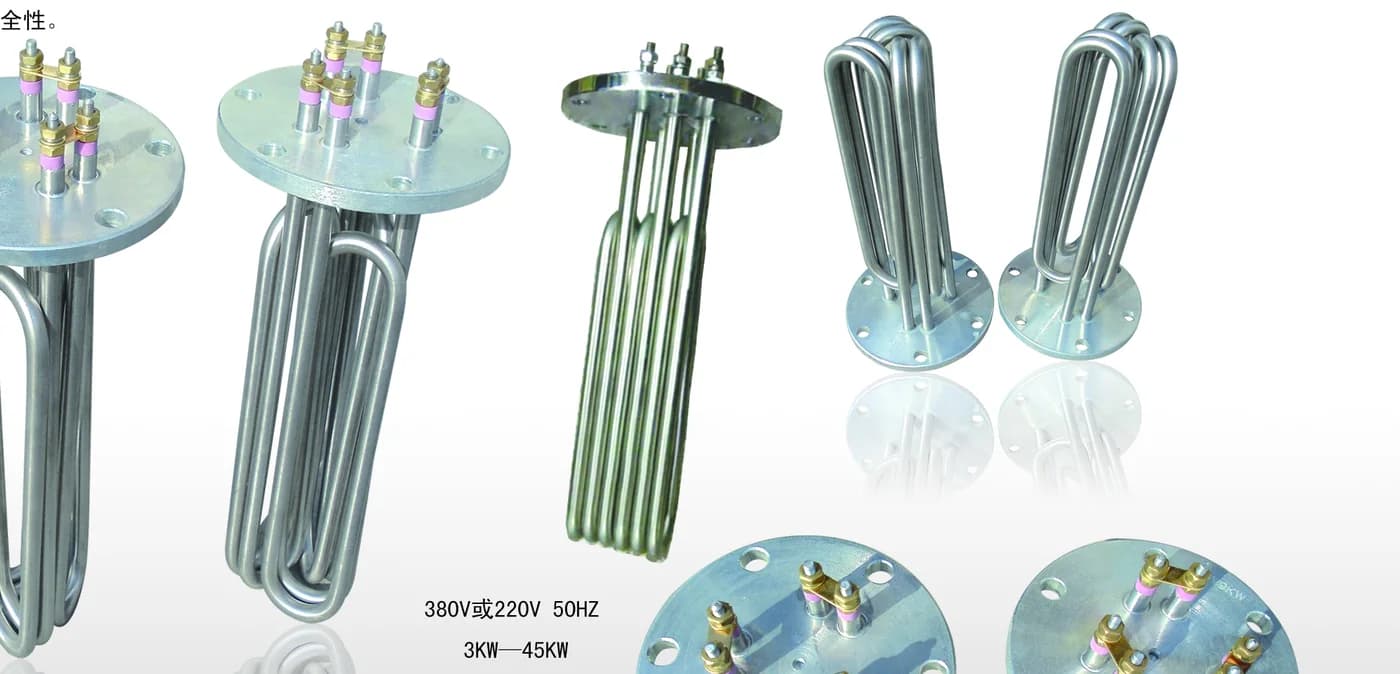 JGGSur plan
Générateur de vapeur électrique
Unités compactes de 3 à 45 kW en 220 V ou 380 V, 50 Hz
- Temp. max.
- 356 °F
- Puissance
- 3–45 kW
- Références
- 10