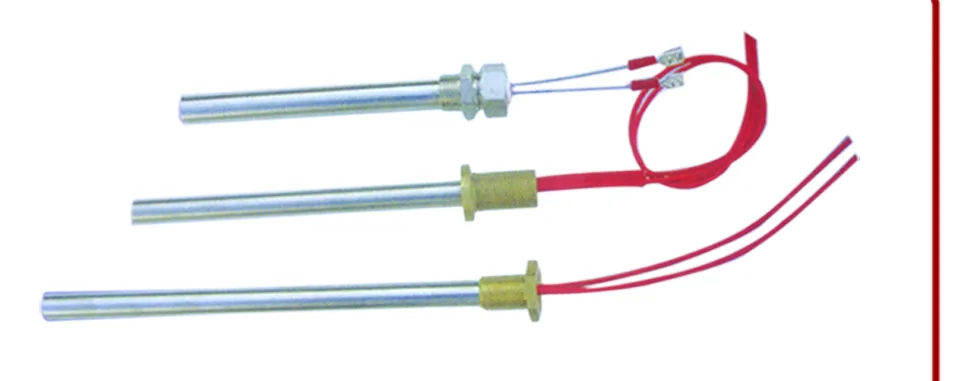
Threaded-boss single-head cartridge heaters for screw-in installation
Cartouche filetée et à sortie à angle droit
螺纹安装 / 直角单头电热管
Cartouche chauffante à bossage fileté intégré pour montage vissé, et versions à sortie à angle droit pour les installations sans dégagement axial.
- Max medium temperature
- 1202 °F(650 °C)
- Power range
- 0.05 – 2 kW
- Voltage
- 110 / 220 / 380 V, 50 Hz
- Sheath material
- 304 stainless, 316 stainless
- Medium
- Metal / mold
- Mounting
- Threaded boss, Bore insert
- Tube diameter
- 0.315–0.63 in
- Watt density guidance
- 10–30 W/cm² (65–194 W/in²)
- Lead time
- 14–24 days
- MOQ
- 20 units
- Pricing
- On application
Design notes
Se visse dans un bossage taraudé ; sort de côté quand la place manque
A threaded cartridge screws into a tapped boss instead of being pressed into a plain bore. That gives a repeatable, removable fit and a positive mechanical retention — useful on equipment where heaters are changed regularly, and on anything that vibrates enough to walk a press-fit cartridge out of its bore.
The right-angle variant takes the leads out of the side of the head rather than the end. On a mold plate with a bolster close behind it, or a manifold in a tight pocket, that is often the difference between an installation that works and one that needs the tool re-machined.
Both variants are offered with integral thermocouples, sealed lead exits for damp or oily environments, and a temperature-controllable build where the control sensor is embedded with the heater.
Features
- Bossage fileté intégré — positionnement répétable, démontable, insensible aux vibrations
- Sortie à angle droit pour dégagement axial restreint
- Version thermorégulée avec capteur intégré
- Sortie de conducteurs étanche pour ambiances humides et huileuses
- Formes de filetage métriques et BSP courantes
Typical applications
- Plaques de moule à faible dégagement arrière
- Machines vibrantes où les cartouches à emmanchement migrent
- Positions de chauffe changées fréquemment sur outillage de production
- Chauffage de blocs de vannes et de distribution
- Chauffage de coffrets d'instrumentation et d'analyseurs
North American build options
- Voltage
- 120 / 208 / 240 / 277 / 480 / 600 V @ 60 Hz
- Threads
- NPT or BSP cut to order
- Flanges
- ANSI B16.5 150# / 300#
- Drawings
- Issued in inches on request
These are build options, not stock items — the catalog part numbers above are 50 Hz with metric fine threads. State what you need on the RFQ.
Part numbers & dimensions
8 catalog part numbers in the JGD-T series
State the thread form and the seating face you need. Metric fine, BSP and NPT bosses are all available; give us the tapped detail on your tool and the boss will be cut to match it.
Minimum order quantity for this series is 20 units. Dimensions switch between millimetres and inches with the unit toggle in the header.
Full specification
- Sheath material
- 304 or 316 stainless
- Diameter range
- Ø8 – Ø16 mm
- Max. sheath temperature
- 650 °C
- Watt density
- 10–30 W/cm² (65–194 W/in²)
- Mounting
- Integral threaded boss — thread form to order
- Lead exit
- Axial or right-angle
- Voltage
- 110 / 220 / 380 V
- Sensor
- Optional embedded thermocouple
Questions engineers ask
How tight should a threaded cartridge be done up?
Firm, not forced. The manufacturer's guidance for terminal and mounting hardware is to hold one nut against another when tightening and to avoid excessive force — over-torquing a boss distorts the sheath and can shear the seal at the head. Seat it against the face and stop.
Does a threaded cartridge heat as well as a press-fit one?
It depends on where the heat crosses into the block. A threaded boss makes contact at the thread flanks and the seating face, which is a smaller and less consistent contact area than a full-length interference fit. For maximum heat transfer, a press-fit into a reamed H7 bore wins. Threaded builds are chosen for retention, removability and vibration resistance rather than for conduction.
Commonly specified with
Related series
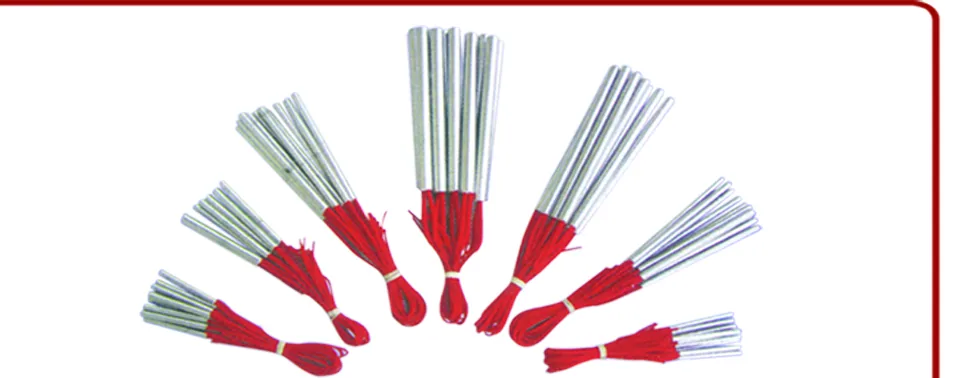 JGD-HSur plan
Cartouche chauffante haute densité
Construction rétreinte pour blocs chauds, matrices et plateaux
- Temp. max.
- 1382 °F
- Puissance
- 0.05–3 kW
- Références
- 9
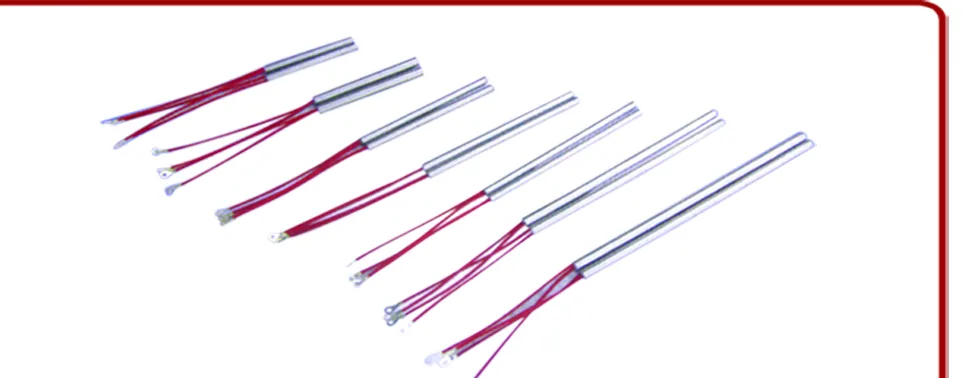 JGD-MSur plan
Cartouche chauffante densité moyenne et basse
Tolérante à l'ajustement, plus durable en outillage courant
- Temp. max.
- 1022 °F
- Puissance
- 0.05–2 kW
- Références
- 8