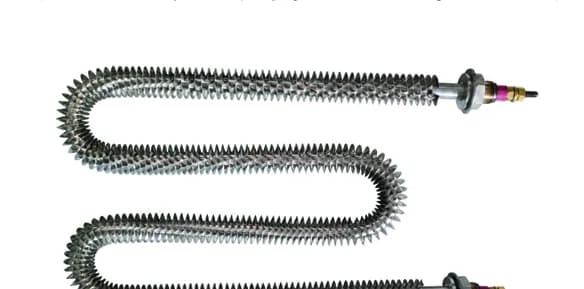
Spiral-finned tubular air heater in serpentine form with brass terminals
Finned Tubular Air Heater
散热片加热管
Tubular element with a spiral steel or stainless fin welded along the sheath, raising heat-transfer area so a duct carries more kilowatts at the same sheath temperature.
- Max medium temperature
- 572 °F(300 °C)
- Power range
- 0.5 – 6 kW
- Voltage
- 220 / 380 V, 50 Hz
- Sheath material
- 10# steel, 304 stainless
- Medium
- Air
- Mounting
- Bracket, Threaded boss, Bore insert
- Tube diameter
- 0.63 in
- Watt density guidance
- up to 3.5 W/cm² (23 W/in²) in forced convection
- Lead time
- 15–25 days
- MOQ
- 10 units
- Pricing
- On application
Design notes
Three times the surface area in the same duct width
A finned element solves the problem that limits every air heater: air will only take so much heat from a given area of tube. Winding a continuous fin onto the sheath and welding it down roughly triples the effective surface, so the same duct cross-section can carry substantially more kilowatts without raising the sheath temperature that decides element life.
Fin material follows the air. Carbon-steel fin is standard for clean, dry heating. Stainless fin is used where the air carries moisture, food residue or mildly corrosive vapor, and where wash-down is part of the cleaning routine.
The trade-off is that fins need moving air. In still air a fin can actually make matters worse — it blankets the tube and the heat has nowhere to go. Finned elements belong in ducts, unit heaters and forced-convection ovens where a fan sweeps them continuously, and should be interlocked with airflow proving so they cannot energize against a stopped fan.
Features
- Spiral fin continuously welded to the sheath — no loose contact resistance
- Roughly 3× the bare-tube heat-transfer area
- Carbon-steel or stainless fin to suit air quality and wash-down
- Also supplied as unheated finned tube for steam radiator duty
- Formed to duct width, bend form and bracket layout on request
Typical applications
- HVAC duct heating and reheat batteries
- Unit heaters and air curtains
- Forced-convection drying ovens
- Grain and timber kiln air heating
- Steam radiator replacement (unheated finned tube)
North American build options
- Voltage
- 120 / 208 / 240 / 277 / 480 / 600 V @ 60 Hz
- Threads
- NPT or BSP cut to order
- Flanges
- ANSI B16.5 150# / 300#
- Drawings
- Issued in inches on request
These are build options, not stock items — the catalog part numbers above are 50 Hz with metric fine threads. State what you need on the RFQ.
Part numbers & dimensions
8 catalog part numbers in the JGF series
Finned elements are usually made to the duct dimension. Give us the free width and depth, the airflow in m³/h and the required temperature rise and we will size the battery rather than the element alone.
Minimum order quantity for this series is 10 units. Dimensions switch between millimetres and inches with the unit toggle in the header.
Full specification
- Sheath material
- 10# steel or 304 stainless
- Fin material
- Carbon steel or stainless
- Tube diameter
- Ø16 mm
- Max. medium temperature
- 300 °C
- Effective area gain
- ≈ 3× bare tube
- Airflow requirement
- Forced convection; interlock with airflow proving
- Voltage
- 220 V or 380 V, 50 Hz
- Power range
- 0.5 – 6 kW per element
Questions engineers ask
When should I choose a finned element over a plain tube?
When the kilowatts will not fit the duct at a safe watt density. A finned element gives roughly three times the surface area in the same width, so you can carry the load without raising sheath temperature. The prerequisite is moving air — in still air the fin blankets the tube and makes the situation worse, not better.
Do I need an airflow interlock?
Yes. A finned element energized against a stopped fan fails quickly, and in a duct with combustible dust or product residue it is a fire risk. Wire a differential pressure switch or a sail switch into the heater contactor coil so the heater physically cannot run without proven airflow.
What is the unheated finned tube for?
It is a steam radiator element. Steam or hot water is passed through the tube and the fins release the heat into the room, replacing a conventional hydronic radiator in workshops, greenhouses and drying rooms. It is the same finned tube without a resistance coil inside.
Commonly specified with
Related series
 JGQTo drawing
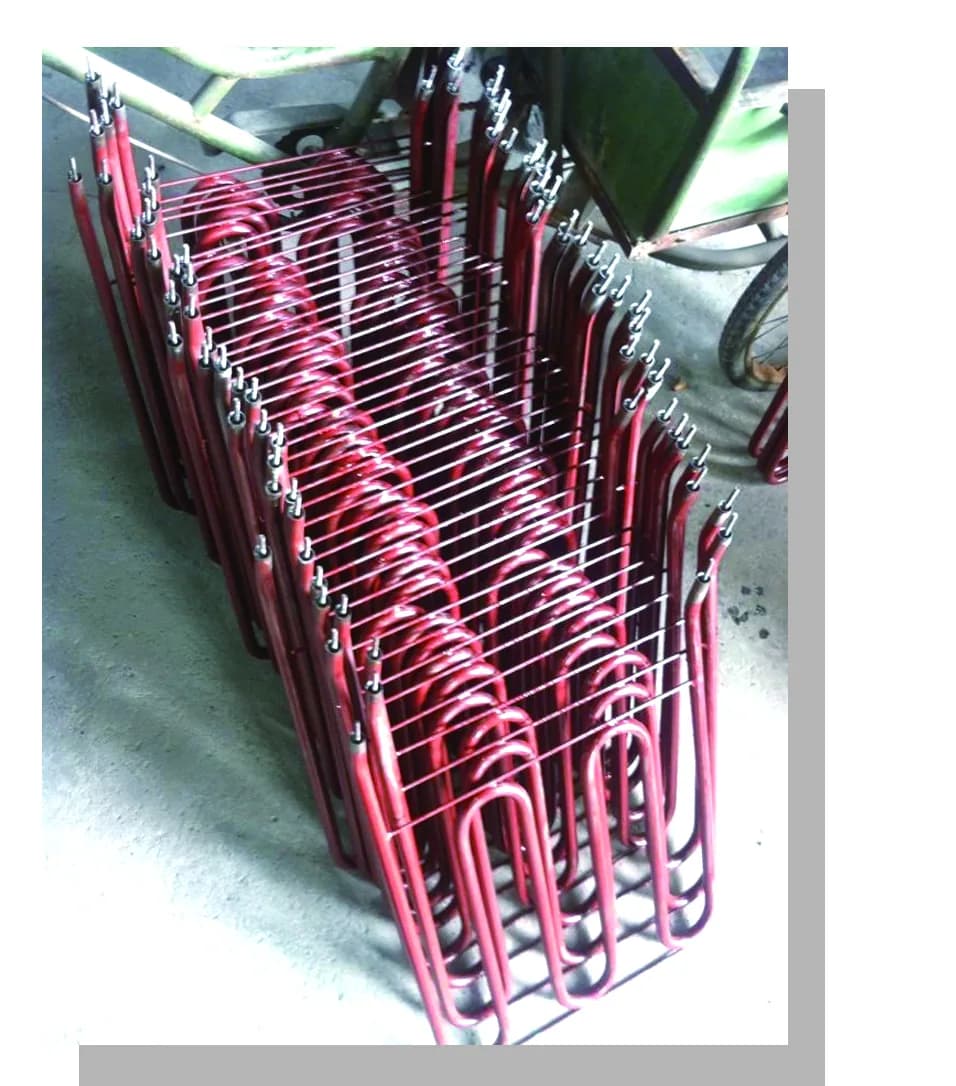
JGQ Tubular Air-Heating Element
Six bend geometries, 0.25–3.0 kW, 36 V to 380 V
- Max temp
- 572 °F
- Power
- 0.25–3 kW
- Part numbers
- 24
 JGOTo drawing
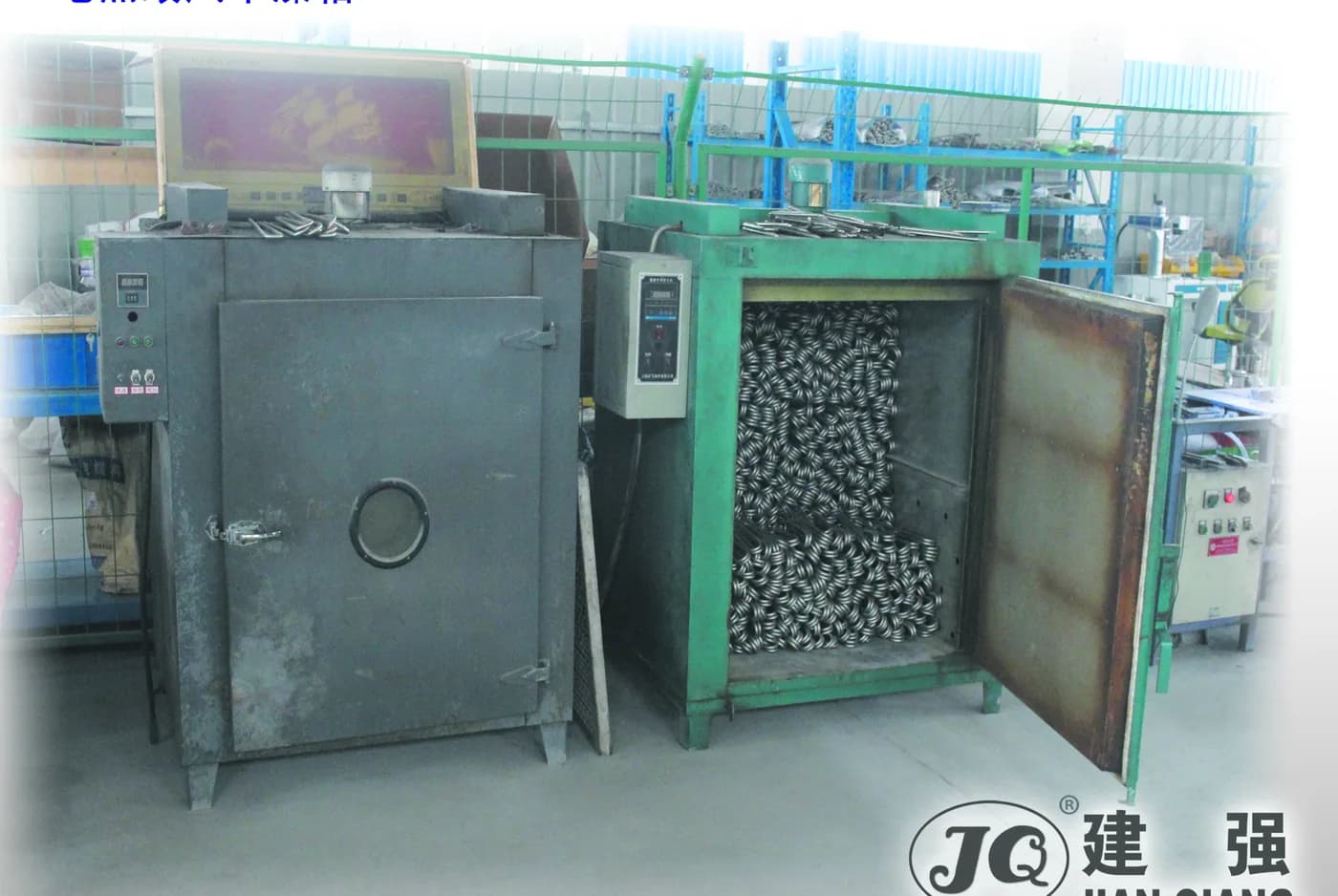
Electric Blast Drying Oven
Forced-convection drying and curing to 300 °C
- Max temp
- 572 °F
- Power
- 1–15 kW
- Part numbers
- 6
 JGCTo drawing
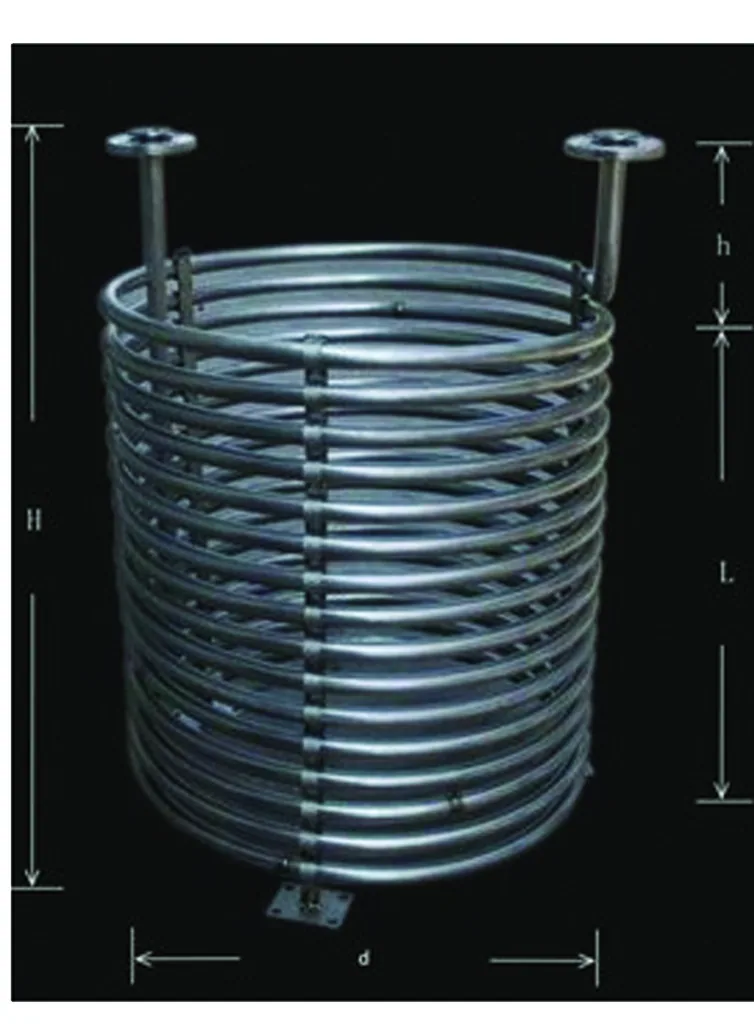
Steam & Process Coil Tube
Helical and flat-spiral coils wound to your vessel
- Max temp
- 572 °F
- Power
- —
- Part numbers
- 8