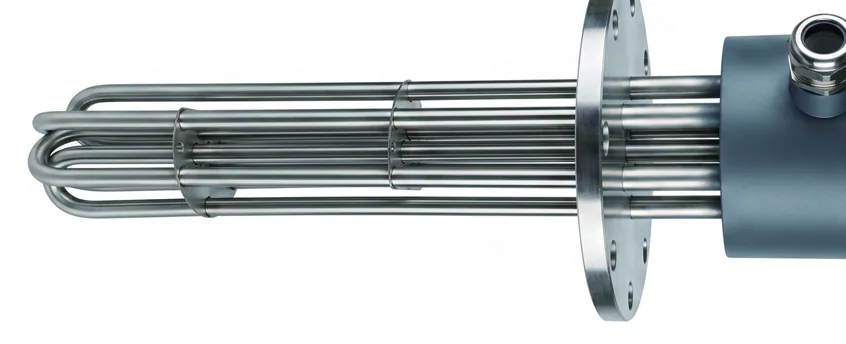
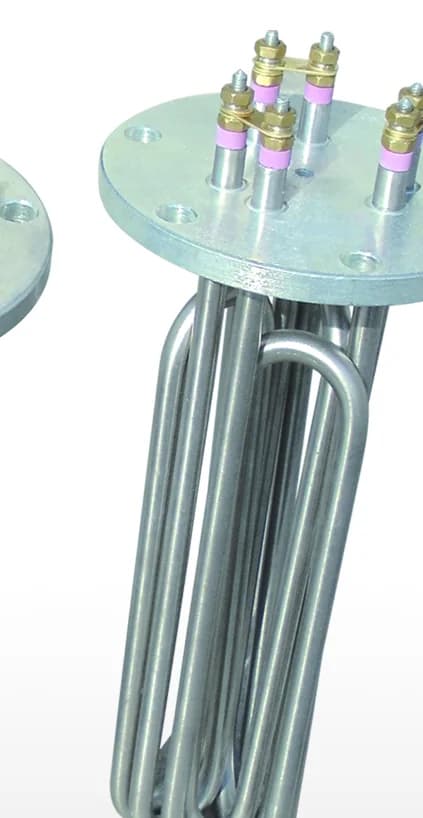
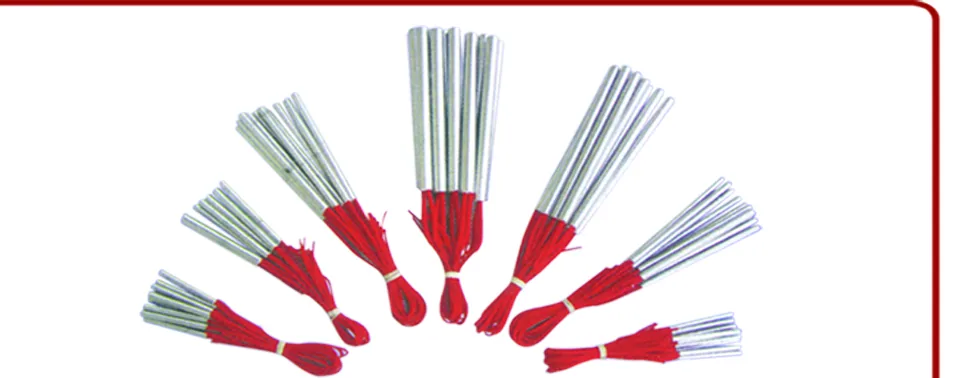
A heating element that reaches its design life dies of old age in the resistance coil. Almost nothing does. The failures that actually fill the returns bin are a short list, and most are decided before the heater is ever energized.
1. Dry firing
The liquid level falls below the heated zone and the exposed section, now cooled only by air, climbs past its sheath limit in seconds to minutes. This is the fastest and most complete failure mode there is. The fix is a low-level cut-out wired into the heater contactor — not into the controller, into the contactor — so the heater physically cannot energize against a low level. It costs a fraction of the element it protects.
2. Scale and carbon
In hard water, calcium carbonate deposits on the sheath. In oil, the film in contact with a hot tube cracks into carbon. Both are insulators, so heat that used to leave into the medium is trapped, the sheath runs hotter, and the deposit grows faster — the element is destroyed by its own output. The manufacturer's maintenance instruction is direct: when scale or carbon appears on the tube surface, clean it off promptly before it affects heat dissipation and shortens service life.
3. Watt density set too high
The most common specification error. The required kilowatts are forced into the available space, the density ends up above what the medium tolerates, and the element fails at a fraction of its rated life. Look at the density table before agreeing a heated length; if the number does not fit, add surface area rather than accepting the density.
4. Wrong sheath for the chemistry
Recognisable by where the damage is: pitting concentrated along the liquid line, where the metal is wetted, oxygenated and thermally cycled. This is a corrosion failure, not a thermal one, and no control change fixes it — the element has to be rebuilt in the right alloy.
5. Moisture in the magnesium oxide
MgO is hygroscopic. An element stored in a damp warehouse absorbs moisture and its insulation resistance falls, sometimes to the point of tripping an earth-leakage device on first energization. This is the one failure on the list that is usually repairable: the manufacturer's instruction is to store elements in a dry place, and where insulation resistance has fallen below 1 MΩ at 500 V, to bake the element at around 200 °C until it recovers, or to bring it up gradually at reduced voltage until resistance returns.
6. Overheating at the lead exit
The heated zone is fine and the failure is at the termination. Two causes: the lead exit has been buried inside the insulation layer instead of sitting outside it, so the terminal end runs at insulation temperature; or corrosive, explosive or damp media have reached the terminals. The manufacturer's guidance is explicit — the wiring section should be positioned outside the insulation layer, kept away from corrosive and moist media, and the lead-out wire should be able to withstand the terminal-end temperature and the electrical load over the long term.
The interlock checklist
- Low-level cut-out breaking the heater contactor on every liquid application
- Airflow proving switch in the contactor circuit on every forced-air application
- Independent over-temperature device on its own sensor and its own break path
- Insulation-resistance check before first energization and after any long storage
- Terminal enclosure rated for the environment, positioned outside the insulation
- Scheduled descale or carbon clean where the medium deposits
Frequently asked
My element reads low insulation resistance out of the box. Is it faulty?
Probably not — it is probably damp. Magnesium oxide absorbs moisture in storage, and the manufacturer's remedy is to bake the element at around 200 °C until insulation resistance recovers, or to energize it at a reduced voltage until it comes back. Test it again after drying before condemning it. A genuinely faulty element will not recover.
How quickly does dry firing destroy an element?
Seconds to minutes, depending on watt density. Air removes heat roughly two orders of magnitude more slowly than water or oil, so an exposed heated zone has nowhere to send its output and goes past the sheath limit almost immediately. This is why a low-level interlock is wired to the contactor rather than to the controller — it has to break power without waiting for a control decision.
Is descaling worth doing, or should I just replace the element?
Descale, and do it before performance degrades noticeably. Scale is self-accelerating: it insulates, the sheath runs hotter, and the deposit grows faster under the higher surface temperature. Cleaning early is cheap; cleaning after the element has been running hot under a deposit for months often just reveals a heater that is already at the end of its life.
Why does the terminal end fail when the heated zone looks perfect?
Because the termination has been built into a hot pocket, or moisture and corrosive vapor have reached it. The lead exit belongs outside the insulation layer, not inside it, and the lead-out wire has to be rated for both the terminal-end temperature and the electrical load in the long term. This is an installation detail rather than a heater defect, and it accounts for a surprising share of returns.