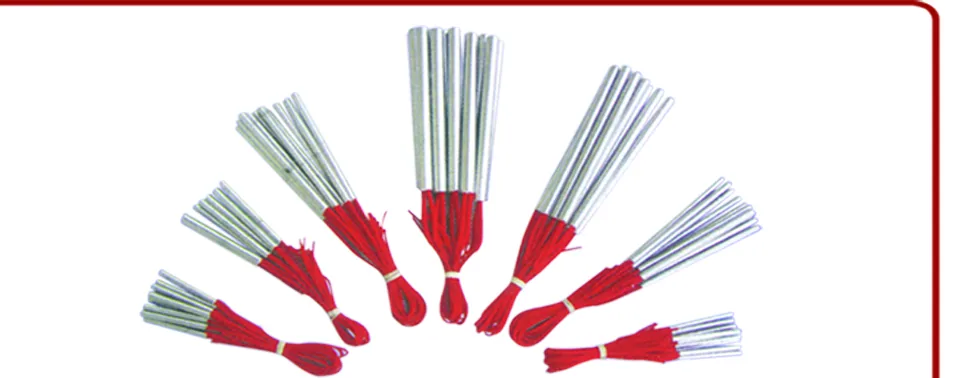
High watt density single-head cartridge heaters with red lead sleeving
High Watt Density Cartridge Heater
高功率密度单头电热管
Single-ended swaged cartridge heater for high-output bore heating in molds, dies, platens and hot-runner manifolds. Requires a reamed bore — fit decides service life.
- Max medium temperature
- 1382 °F(750 °C)
- Power range
- 0.05 – 3 kW
- Voltage
- 110 / 220 / 380 V, 50 Hz
- Sheath material
- 304 stainless, 316 stainless, Incoloy 800
- Medium
- Metal / mold
- Mounting
- Bore insert, Threaded boss
- Tube diameter
- 0.256–0.787 in
- Watt density guidance
- up to 45 W/cm² (290 W/in²) with a reamed H7 bore
- Lead time
- 12–22 days
- MOQ
- 20 units
- Pricing
- On application
Design notes
Swaged construction for hot runners, dies and platens
A high watt density cartridge packs a tightly wound coil, high-purity MgO and a swaged sheath into a small diameter, then relies on the surrounding metal to carry heat away. When the fit is right the block conducts heat off the sheath as fast as the coil makes it, and the cartridge lives a long time at an output that would destroy an air heater.
When the fit is wrong, the air gap between cartridge and bore acts as insulation and sheath temperature climbs sharply. This is why bore preparation matters more than any catalog parameter for this product: a reamed H7 bore, clean and free of scale, is the difference between years of service and weeks. Oversized, worn or oval bores need a lower-density cartridge, not a higher-powered one.
Supplied with fiberglass or stainless-overbraid leads, right-angle exits where clearance is short, threaded mounting bosses, integral type-J or type-K thermocouples for closed-loop control, and corrosion-resistant sheaths for damp or chemically aggressive environments.
Features
- Swaged construction for maximum coil-to-sheath contact
- Diameters from Ø6.5 mm to Ø20 mm
- Integral type-J or type-K thermocouple option
- Right-angle lead exit, threaded boss and flange options
- Fiberglass, PTFE or stainless-overbraid lead protection
Typical applications
- Injection-mold and hot-runner manifold heating
- Extrusion die and die-head heating
- Press platens and laminating tools
- Packaging sealing bars and hot stamping
- Laboratory heating blocks and fixtures
North American build options
- Voltage
- 120 / 208 / 240 / 277 / 480 / 600 V @ 60 Hz
- Threads
- NPT or BSP cut to order
- Flanges
- ANSI B16.5 150# / 300#
- Drawings
- Issued in inches on request
These are build options, not stock items — the catalog part numbers above are 50 Hz with metric fine threads. State what you need on the RFQ.
Part numbers & dimensions
9 catalog part numbers in the JGD-H series
Diameter, heated length, wattage, voltage, lead type and thermocouple are all built to order. The codes above are common combinations — send your bore diameter, depth and required wattage and we will confirm the density before quoting.
Minimum order quantity for this series is 20 units. Dimensions switch between millimetres and inches with the unit toggle in the header.
Full specification
- Sheath material
- 304 / 316 stainless, Incoloy 800
- Diameter range
- Ø6.5 – Ø20 mm
- Max. sheath temperature
- 750 °C
- Watt density
- up to 45 W/cm² (290 W/in²) with correct bore fit
- Required bore
- Reamed H7, clean and scale-free
- Voltage
- 110 / 220 / 380 V
- Thermocouple
- Optional integral type J or type K
- Lead exit
- Axial or right-angle
- Lead protection
- Fiberglass, PTFE or stainless overbraid
Questions engineers ask
What bore tolerance does a high density cartridge need?
A reamed H7 bore, clean and free of scale. The air gap in a loose bore is an insulator: it traps the heat the cartridge is producing and pushes sheath temperature up sharply, which is by far the most common cause of premature cartridge failure. If your bores are worn, oversized or oval, specify a lower watt density rather than trying to compensate with more power.
Why did my cartridge fail at the lead end rather than in the heated zone?
Almost always heat or contamination at the termination. The manufacturer's own guidance is explicit: the lead exit should sit outside the insulation layer, not buried inside it, and the magnesium-oxide at the terminal end must be kept clear of moisture and contaminants or it loses dielectric strength and a leakage fault develops. Check that the exit is not enclosed in a hot pocket and that the leads are not being flexed at the seal.
Should I specify an integral thermocouple?
Yes, for anything running above about 20 W/cm² or where the block temperature must be held closely. A thermocouple in the block reads the metal with a lag; one built into the cartridge reads much closer to the sheath, which is what protects the heater. For hot-runner work an integral type J or K is effectively standard.
How should cartridges be stored between jobs?
In a dry store. The manufacturer's instruction is to megger the element before use and, if insulation resistance has fallen below 1 MΩ at 500 V, to dry it in an oven at around 200 °C until it recovers. Magnesium oxide is hygroscopic, so a cartridge that has sat in a damp workshop can read low without being faulty — dry it before you condemn it.
Commonly specified with
Related series
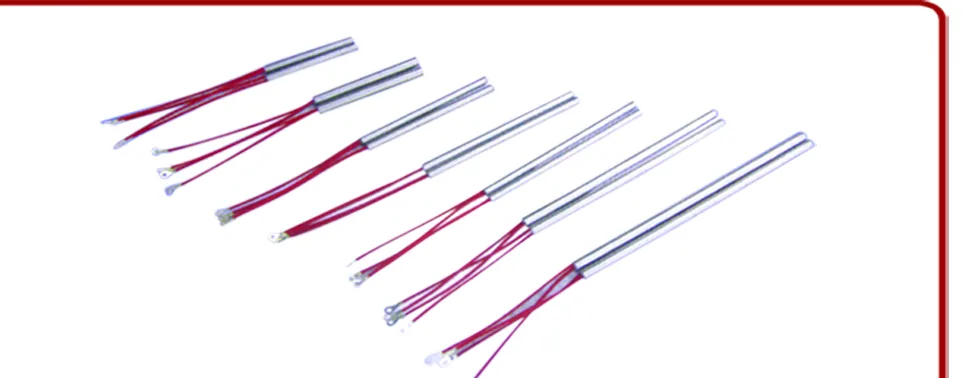 JGD-MTo drawing
Medium & Low Density Cartridge Heater
Forgiving of bore fit, longer life in general fixtures
- Max temp
- 1022 °F
- Power
- 0.05–2 kW
- Part numbers
- 8
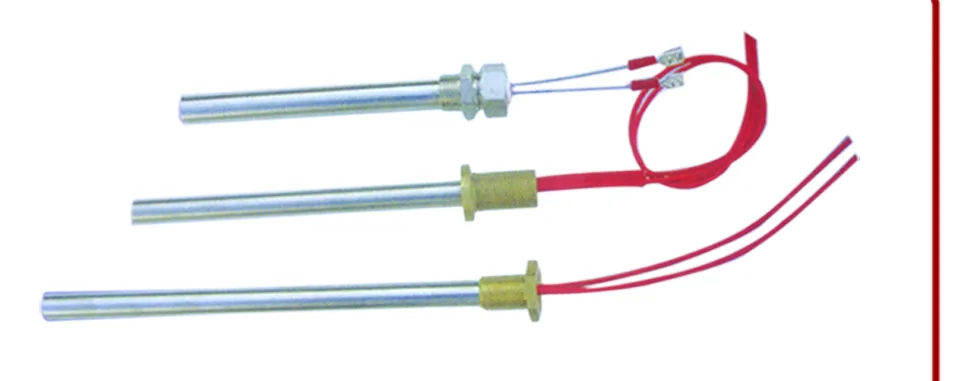 JGD-TTo drawing
Threaded & Right-Angle Cartridge Heater
Screws into a tapped boss; exits sideways where clearance is short
- Max temp
- 1202 °F
- Power
- 0.05–2 kW
- Part numbers
- 8
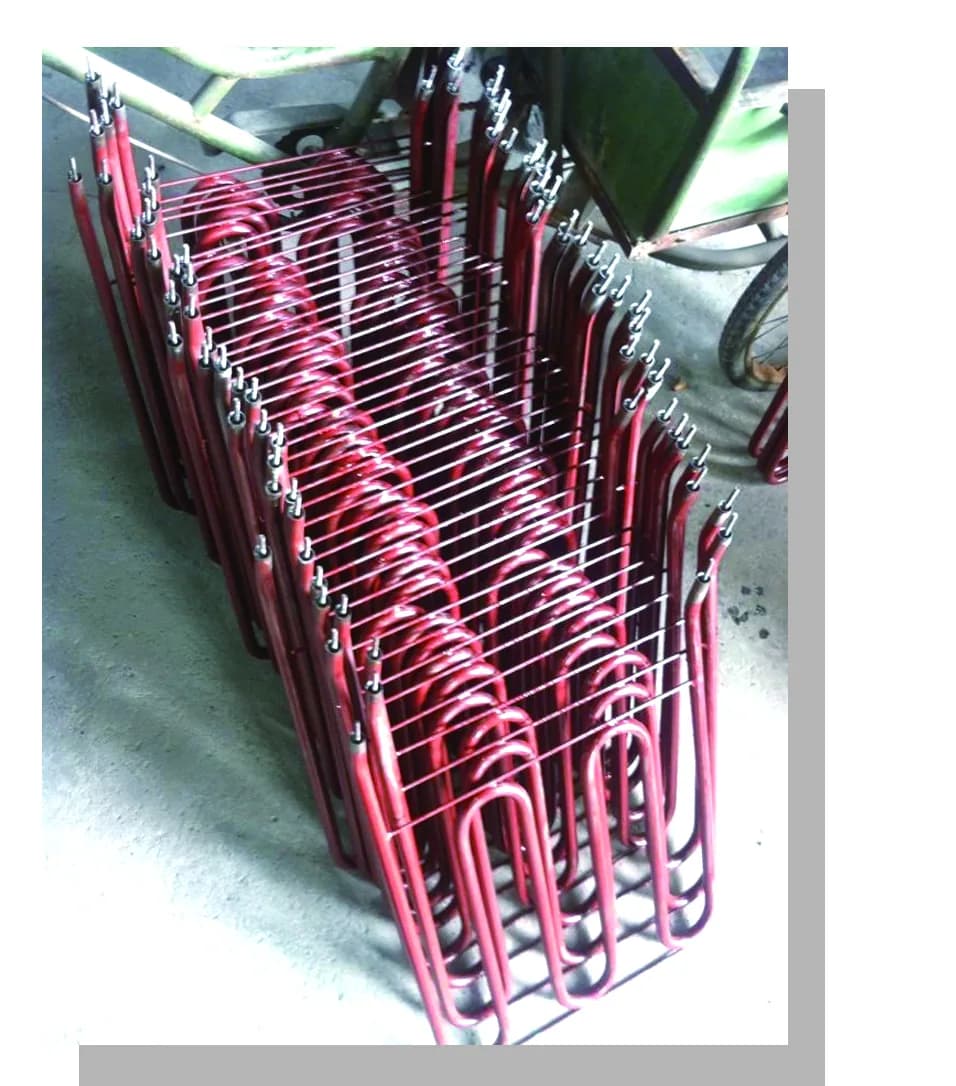 JGQTo drawing
JGQ Tubular Air-Heating Element
Six bend geometries, 0.25–3.0 kW, 36 V to 380 V
- Max temp
- 572 °F
- Power
- 0.25–3 kW
- Part numbers
- 24