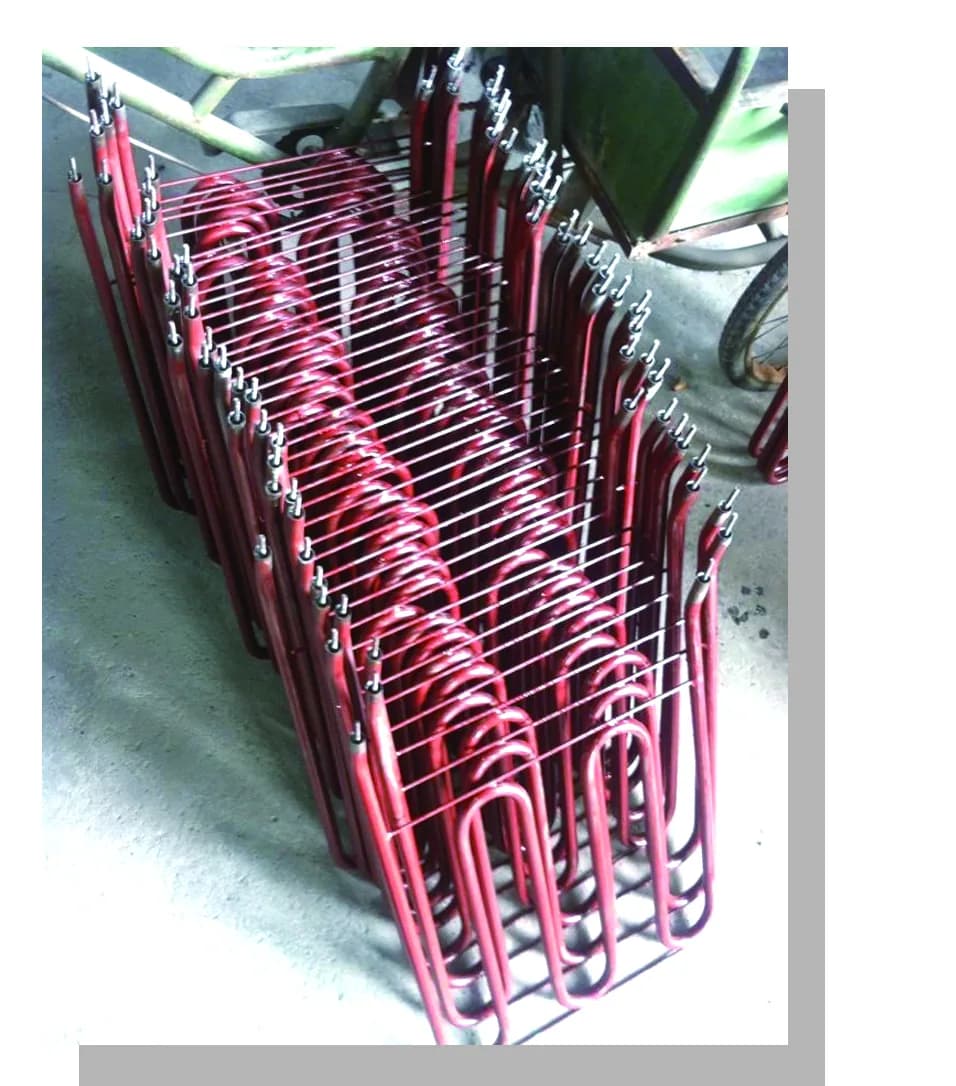
Racks of formed JGQ hairpin air-heating elements with red identification sleeves
JGQ Tubular Air-Heating Element
JGQ 型管状电热元件
Metal-sheathed tubular element for heating air in ovens, drying tunnels, ducts and electric furnaces. 10# steel sheath, 300 °C maximum medium temperature, 45 mm fastening boss with an M22×1.5 nut.
- Max medium temperature
- 572 °F(300 °C)
- Power range
- 0.25 – 3 kW
- Voltage
- 36 / 55 / 110 / 220 / 380 V, 50 Hz
- Sheath material
- 10# steel, 304 stainless
- Medium
- Air
- Mounting
- Threaded boss, Bracket, Bore insert
- Tube diameter
- 0.63 in
- Watt density guidance
- ≤ 2 W/cm² (13 W/in²) recommended in still air
- Lead time
- 12–20 days
- MOQ
- 20 units
- Pricing
- On application
Design notes
Six bend geometries, 0.25–3.0 kW, 36 V to 380 V
The JGQ series is the workhorse element behind most Chinese-built drying and baking equipment. A nickel-chrome or iron-chrome-aluminum resistance coil runs down the axis of a Ø16 mm steel tube, the annulus is packed with compacted fused magnesium oxide, and both ends are swaged and sealed with silicone. The result conducts heat well, insulates electrically, and survives the vibration and thermal shock of a production line.
Six bend forms cover the usual mounting problems. JGQ1 and JGQ2 are single and double hairpins for shallow plenums. JGQ3 is a triple hairpin where more kilowatts have to fit a fixed width. JGQ4 is a long, narrow U for duct walls. JGQ5 is a deep serpentine for tall ovens. JGQ6 is a compact low-voltage form for 36, 55 and 110 V control circuits and equipment that must run at safety extra-low voltage.
Because air is a poor heat-transfer medium, watt density is the number that matters. Where an oil heater can push past 3 W/cm², an air element in still air should stay near 2 W/cm² or the sheath climbs toward its oxidation limit and the coil fails long before its rated life. Where the design brief needs more kilowatts than the duct area allows, the answer is a finned element rather than a hotter plain tube.
Features
- Ø16 mm tube, 45 mm fastening boss, M22×1.5 fastening nut
- Compacted fused MgO fill for high dielectric strength and fast conduction
- Silicone-sealed terminations resist moisture ingress in storage
- Six standard bend forms; any other geometry made to drawing
- Insulation resistance ≥ 1 MΩ, dielectric strength 2 kV/1 min
Typical applications
- Baking and curing ovens
- Drying tunnels and conveyor dryers
- HVAC duct reheat batteries
- Electric furnaces and heat-treat chambers
- Powder-coating cure lines
North American build options
- Voltage
- 120 / 208 / 240 / 277 / 480 / 600 V @ 60 Hz
- Threads
- NPT or BSP cut to order
- Flanges
- ANSI B16.5 150# / 300#
- Drawings
- Issued in inches on request
These are build options, not stock items — the catalog part numbers above are 50 Hz with metric fine threads. State what you need on the RFQ.
Part numbers & dimensions
24 catalog part numbers in the JGQ series
A/B/C are nominal catalog dimensions. The controlling dimensions on any order are those on the drawing approved before production.
Minimum order quantity for this series is 20 units. Dimensions switch between millimetres and inches with the unit toggle in the header.
Full specification
- Sheath material
- 10# steel (304 stainless on request)
- Tube diameter
- Ø16 mm
- Max. medium temperature
- 300 °C
- Voltage range
- 36 / 55 / 110 / 220 / 380 V, 50 Hz
- Power range
- 0.25 – 3.0 kW
- Fastening boss length
- 45 mm
- Fastening nut
- M22 × 1.5
- Insulation resistance
- ≥ 1 MΩ at 500 V DC
- Dielectric strength
- 2 kV, 1 minute
- Permitted supply tolerance
- ≤ 1.1 × rated voltage
- Ambient humidity
- ≤ 95 % RH, non-explosive, non-corrosive
- Design life
- 10,000 h typical
Questions engineers ask
What watt density should I use for an air-heating element?
Stay near 2 W/cm² in still air and you can go higher — up to about 3.5 W/cm² — where forced convection sweeps the element continuously. Exceeding that in still air raises sheath temperature past the point where the resistance coil oxidizes, and the element fails well short of its 10,000-hour design life. If the kilowatts will not fit at a safe density, add surface area with a finned element rather than pushing the plain tube harder.
Can a JGQ element be run vertically?
Yes, and for air heating there is no restriction. The rule that matters more is that the whole heated length stays inside the air stream: any part of the heated zone sitting outside the duct, in still or dead air, will run far hotter than the rest and become the failure point. Keep the unheated cold ends outside the duct wall and the heated length entirely inside it.
Why does the catalog quote a 300 °C maximum when the sheath can go hotter?
300 °C is the maximum medium temperature — the temperature of the air around the element — not the sheath temperature. The sheath always runs hotter than the medium. Rating on medium temperature is what lets you size directly from your process set-point without back-calculating sheath rise.
Do you supply non-catalog lengths and bend forms?
Yes. The six catalog forms cover common oven and duct layouts, but roughly half of what leaves the plant is made to a customer drawing. Send a dimensioned sketch with the kilowatts, voltage, medium and mounting detail and we will quote the formed element against it.
Commonly specified with
Related series
 JGFTo drawing
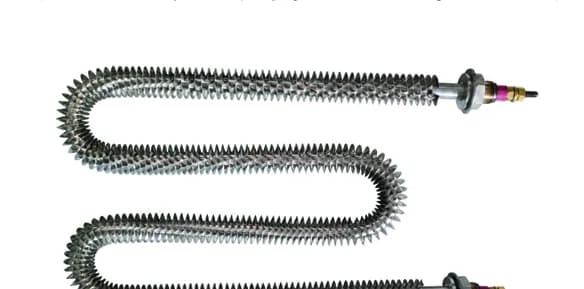
Finned Tubular Air Heater
Three times the surface area in the same duct width
- Max temp
- 572 °F
- Power
- 0.5–6 kW
- Part numbers
- 8
 JGYTo drawing
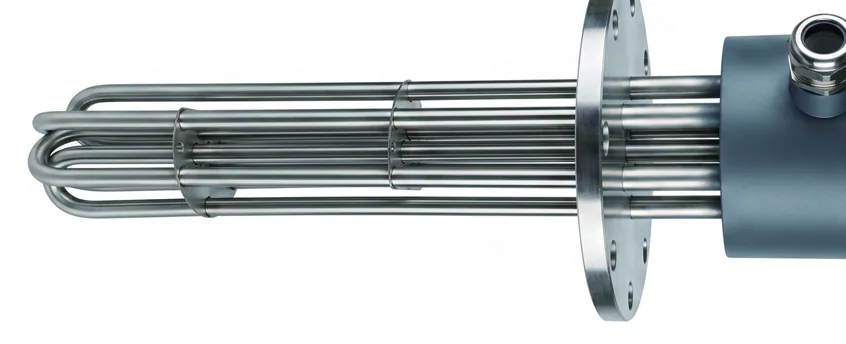
JGY Oil Immersion Heating Element
Open and sealed oil tanks, 1–8 kW at 220 V
- Max temp
- 572 °F
- Power
- 1–8 kW
- Part numbers
- 11
 JGOTo drawing
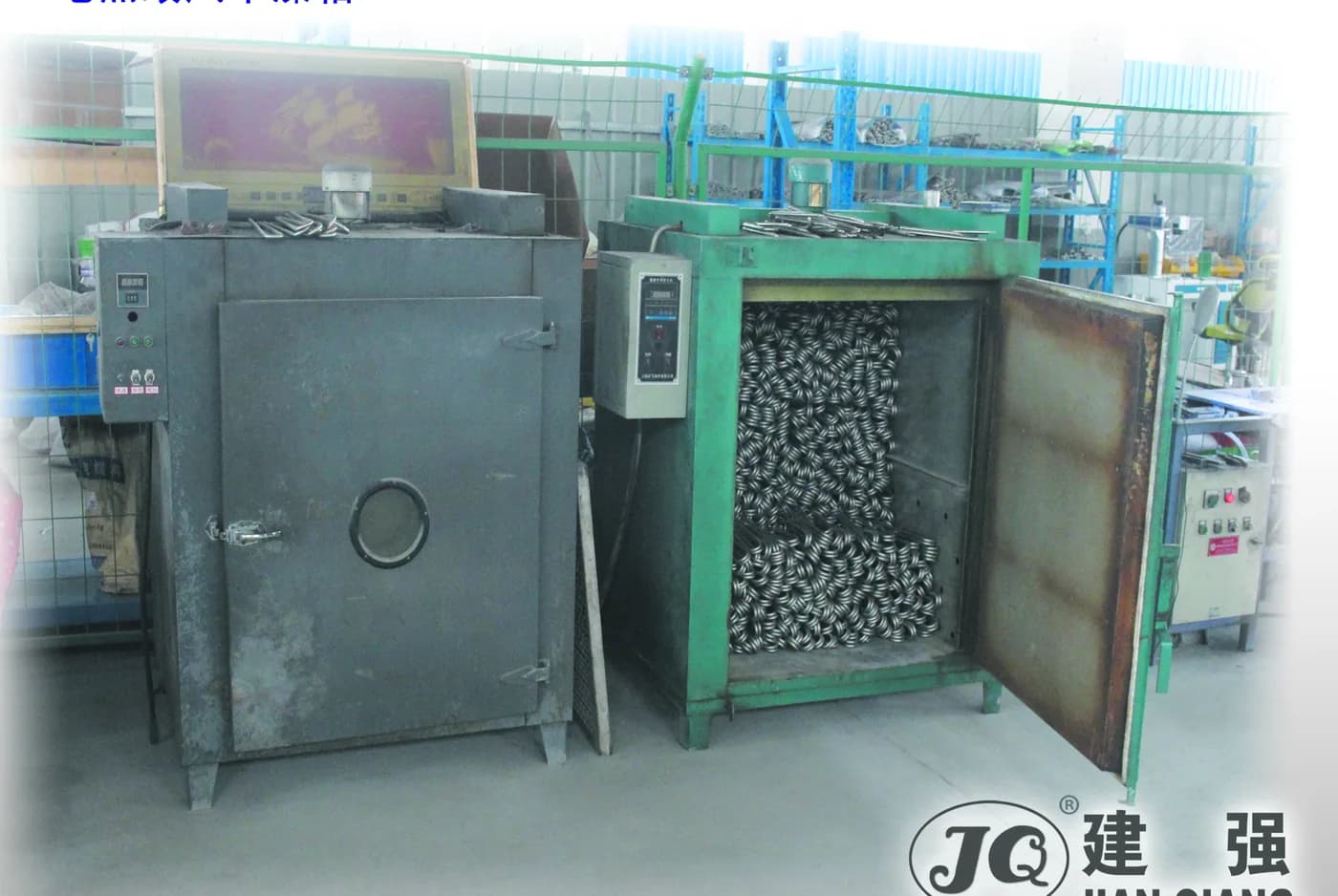
Electric Blast Drying Oven
Forced-convection drying and curing to 300 °C
- Max temp
- 572 °F
- Power
- 1–15 kW
- Part numbers
- 6