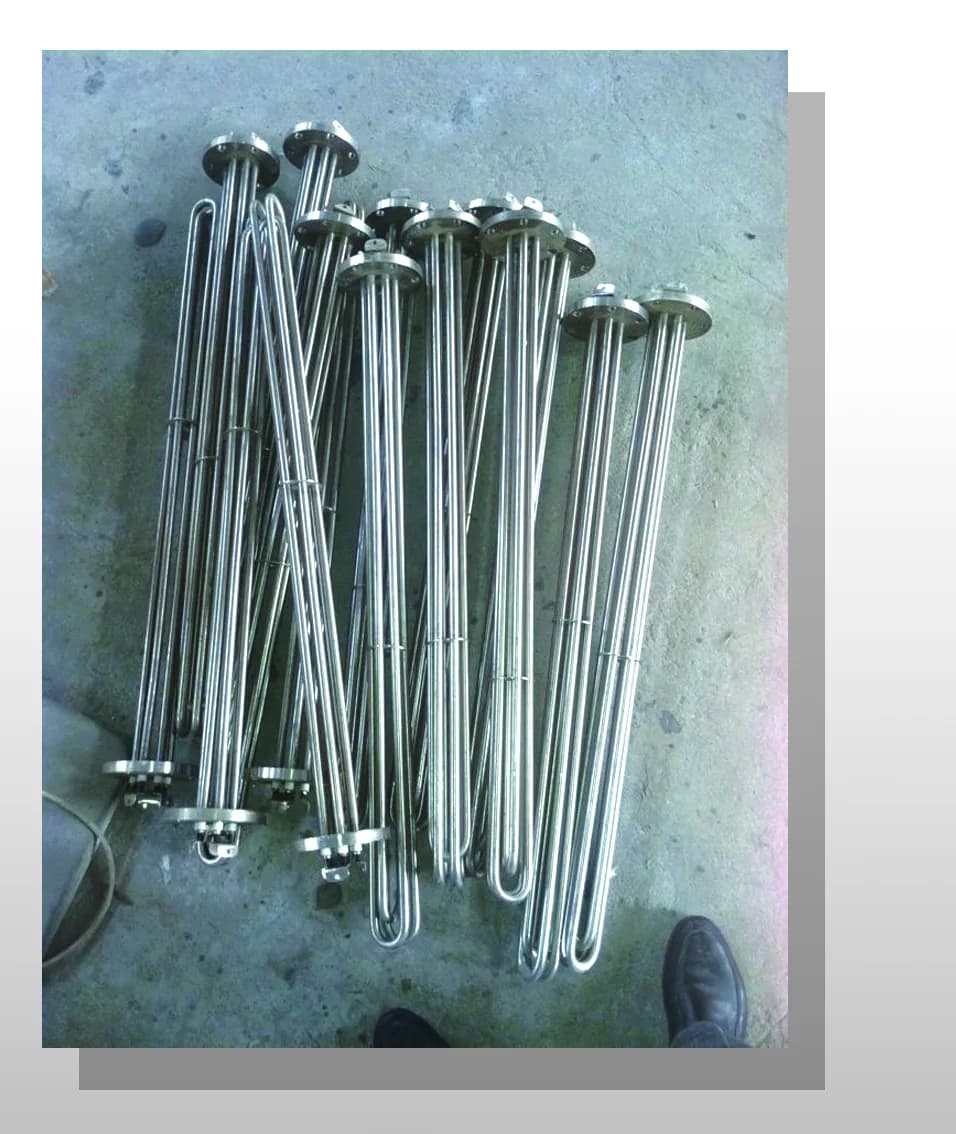
Long-form JGX bath heating elements with terminal ends fitted
JGX / JGJ Salt & Alkali Bath Heater
JGX / JGJ 型硝盐、碱溶液加热管
Heavy-duty tubular element for molten nitrate-salt heat-treatment baths (JGX, stainless sheath) and hot caustic-alkali solution (JGJ, 10# steel sheath). 50 mm fastening boss with an M27×1.5 nut.
- Max medium temperature
- 1022 °F(550 °C)
- Power range
- 2 – 7 kW
- Voltage
- 380 V, 50 Hz
- Sheath material
- 304 stainless, 316 stainless, 10# steel
- Medium
- Nitrate salt, Alkali
- Mounting
- Threaded boss, Bracket
- Tube diameter
- 0.787 in
- Watt density guidance
- ≤ 2.5 W/cm² (16 W/in²) in molten salt
- Lead time
- 20–32 days
- MOQ
- 5 units
- Pricing
- On application
Design notes
500–550 °C bath duty, 380 V, 2–7 kW
These are the hottest elements in the range and the least forgiving to specify. A nitrate-salt bath used for austempering or martempering runs at 500 to 550 °C with a molten salt that is chemically aggressive to carbon steel. A caustic cleaning tank runs cooler but attacks a different set of alloys. The two sheath materials are not interchangeable, which is why the same geometry is cataloged twice under two series codes.
JGX carries a stainless sheath and goes into nitrate salt. JGJ carries a 10# steel sheath and goes into alkali solution. Both use a Ø20 mm tube with a 50 mm fastening boss and an M27×1.5 nut, and both are available in three bend forms: a single deep hairpin (JGX1/JGJ1), a compact U (JGX2/JGJ2), and a double-bend serpentine (JGX3/JGJ3).
Nitrate salt is an oxidizer. It requires a written safety procedure covering overheat protection, moisture exclusion and what materials may enter the bath — the manufacturer's own handling notes call for explosion-prevention measures when heating nitrate. Treat the over-temperature cut-out on a salt bath as a safety device, not a convenience, and wire it to a hard-break contactor independent of the process controller.
Features
- JGX stainless sheath for nitrate salt; JGJ 10# steel sheath for caustic alkali
- 500 – 550 °C maximum medium temperature
- Ø20 mm tube, 50 mm fastening boss, M27×1.5 fastening nut
- Three bend forms — deep hairpin, compact U, double-bend serpentine
- Independent over-temperature element available in the same tube
Typical applications
- Austempering and martempering salt baths
- Heat-treatment salt pots and preheat baths
- Caustic degreasing and paint-stripping tanks
- Aluminum etch and desmut lines
- Wire-patenting lead and salt baths
North American build options
- Voltage
- 120 / 208 / 240 / 277 / 480 / 600 V @ 60 Hz
- Threads
- NPT or BSP cut to order
- Flanges
- ANSI B16.5 150# / 300#
- Drawings
- Issued in inches on request
These are build options, not stock items — the catalog part numbers above are 50 Hz with metric fine threads. State what you need on the RFQ.
Part numbers & dimensions
12 catalog part numbers in the JGX / JGJ series
The B column is the minimum liquid level. Specify JGX for nitrate salt and JGJ for alkali — the sheath alloys are not interchangeable. A/B/C are nominal; approved-drawing dimensions govern.
Minimum order quantity for this series is 5 units. Dimensions switch between millimetres and inches with the unit toggle in the header.
Full specification
- JGX sheath material
- Stainless steel — nitrate salt solution
- JGJ sheath material
- 10# steel — caustic alkali solution
- Max. medium temperature
- 500 – 550 °C
- Tube diameter
- Ø20 mm
- Fastening boss length
- 50 mm
- Fastening nut
- M27 × 1.5
- Voltage
- 380 V, 50 Hz
- Power range
- 2 – 7 kW per element
- Bend radius
- R50 standard on JGX2/JGX3
- Safety requirement
- Over-temperature cut-out and explosion-prevention procedure mandatory on nitrate baths
Questions engineers ask
Why can't I use one sheath material for both salt and alkali?
Because the two chemistries attack different alloys. Molten nitrate salt is an oxidizer and will corrode a carbon-steel sheath, so nitrate baths take the stainless JGX. Hot caustic alkali behaves differently and is better served by the 10# steel JGJ sheath. Ordering the wrong series against your bath is the fastest way to lose an element, so state the bath chemistry on the inquiry rather than only the temperature.
What safety measures does a nitrate salt bath need?
Nitrate salt is an oxidizer and the manufacturer's handling notes call for explicit explosion-prevention measures. At minimum: an independent over-temperature cut-out wired to a hard-break contactor separate from the process controller, strict exclusion of moisture and organic material from the bath, and a written procedure for charging and skimming. Treat the high-limit as a safety instrument, not a control convenience.
How do I start a bath from cold when the salt is solid?
Reduce the applied voltage until the medium has melted, then bring it up to rated volts. The manufacturer's instruction is explicit on this for fusible media — salt, alkali, bitumen and wax alike. Applying full power to an element encased in solid salt gives the heat nowhere to go and destroys the element before the bath is liquid.
What is the minimum liquid level and why does it matter so much?
It is the B dimension in the table — the level below which part of the heated zone is exposed. In a 550 °C salt bath an exposed heated zone fails in seconds, not minutes. Fit a level interlock, and site the element so that normal skimming and drag-out cannot take the bath below that line between top-ups.
Commonly specified with
Related series
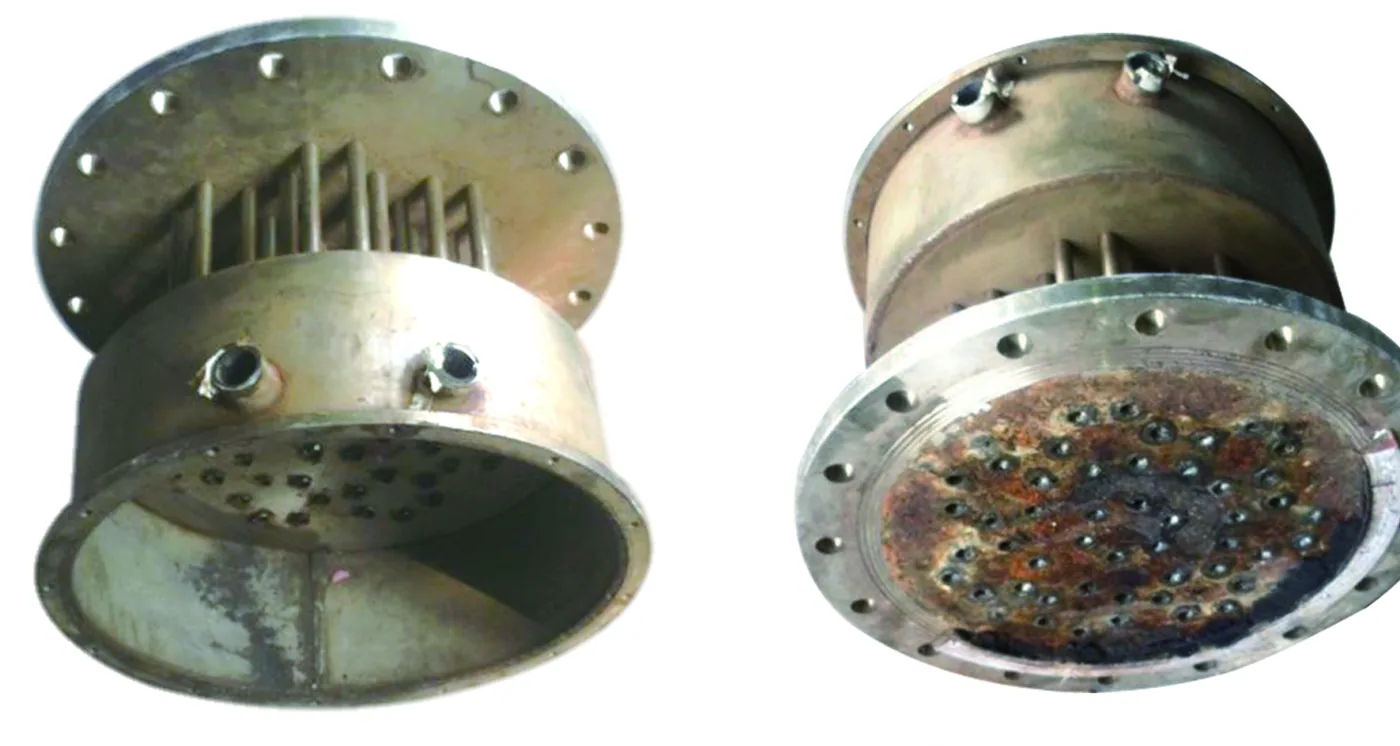 JGBTo drawing
Explosion-Proof Flanged Immersion Heater
Flameproof enclosure, baffled flow path, independent high-limit
- Max temp
- 842 °F
- Power
- 3–200 kW
- Part numbers
- 8
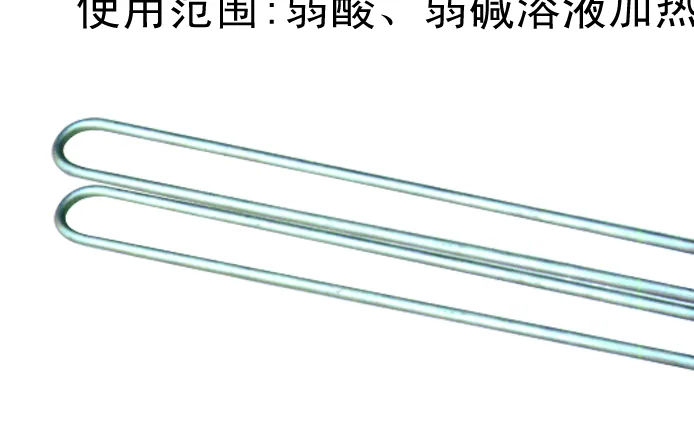 JGS-TiTo drawing
Titanium Immersion Heater
Weak acid and weak alkali service to 100 °C
- Max temp
- 212 °F
- Power
- 0.5–12 kW
- Part numbers
- 7
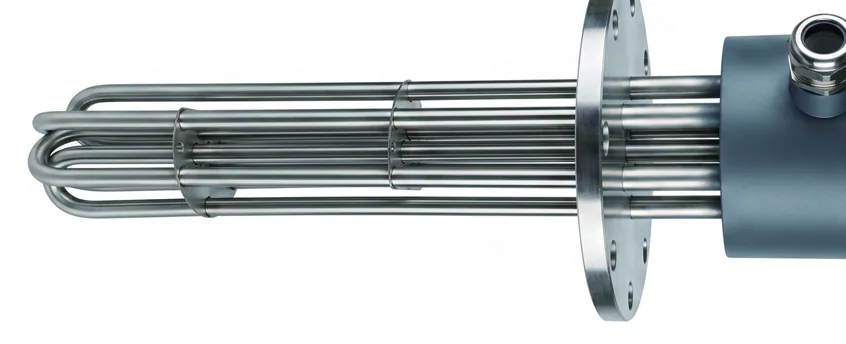 JGYTo drawing
JGY Oil Immersion Heating Element
Open and sealed oil tanks, 1–8 kW at 220 V
- Max temp
- 572 °F
- Power
- 1–8 kW
- Part numbers
- 11